In brief
NiraNexus-OS runs a 3-round adversarial tribunal, not single-pass model averaging. Four frontier models debate — Opening, Cross-Examination, Rebuttal — before any verdict reaches the user. Every claim is labeled VERIFIED, DISPUTED, or UNVERIFIED against retrieved evidence. This log is the operational record of building that system as a solo founder across months of hardening in production.
AI outputs are brittle. A single model hallucinates and there's no check — just a confident wrong answer delivered at speed. The industry's solution — running three models and averaging their outputs — doesn't fix this. It just averages the hallucination into something that sounds even more convincing.
NiraNexus-OS doesn't do that. It runs adversarial deliberation across four frontier models. Opening, Cross-Examination, Rebuttal. Three rounds. One verdict. No single-model hallucination survives.
I named NiraNexus after my daughter Nishka. The name carries what I want this to be: something personal, something that lasts. Infrastructure that doesn't trust a single model's output, ever.
Key Takeaways
- The adversarial pipeline runs three rounds — Opening, Cross-Examination, Rebuttal — across four frontier models before any verdict reaches the user
- Every claim is labeled VERIFIED, DISPUTED, or UNVERIFIED against retrieved evidence, not parametric memory
- Model Council is the first component live. Veritas, the professional deliberation engine, is in development
- This log is the operational record: what shipped, what broke, what we learned
Why not just average multiple model outputs?
Averaging three wrong answers gives you a confident wrong answer. If two models make the same error, the aggregate accepts it blindly — and now it's harder to spot because it sounds like consensus.
Our pipeline forces models to challenge each other directly. A model makes a claim. Another model cross-examines that claim. The original model rebuts or concedes. Only claims that survive all three rounds reach the final synthesis stage — a process that took months to harden across dozens of operating sessions. Irving et al. established the theoretical case for debate as a safety mechanism; we extended that architecture into a production system with persistent deliberation records, source-model attribution, and evidence-grounded labeling.
The infrastructure story that followed is now documented across the Log. Log #2 covers the fire-and-forget database writes that silently lost 57 verdicts. Log #3 traces how a pipeline ordering bug turned a workaround into the failure itself. Log #4 shows how three yield points now guard every debate — execution integrity through governed checkpoints.
What happens in the three rounds?
Opening. Each model states its position independently, citing retrieved evidence. No model sees another model's response.
Cross-Examination. Models review peer claims and challenge factual accuracy, logical consistency, and source quality. The Consilium Protocol showed that structuring this phase with engineered cognitive personas produces more rigorous cross-examination than open-ended critique — a claim with no retrievable URL is rejected outright across all four models.
Rebuttal. The original model defends or concedes. Substantive challenges that cannot be defended are withdrawn. Surviving claims advance.
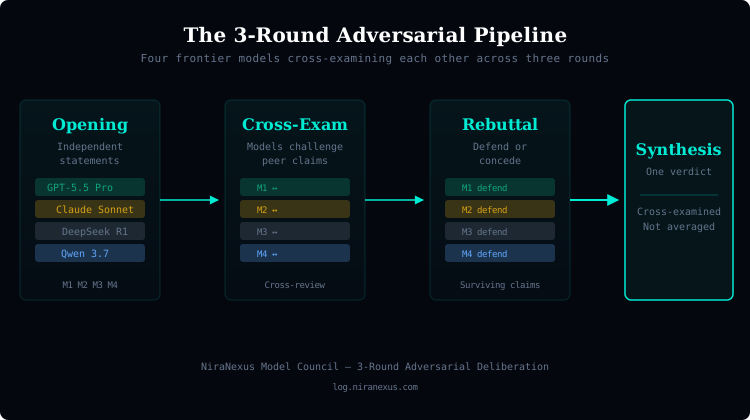
One verdict emerges from the synthesis layer. Not averaged. Cross-examined.
The biggest surprise during development wasn't model hallucination — it was infrastructure. Fire-and-forget database writes lost entire deliberation verdicts. A Promise.race timeout killed synthesis mid-debate. The models worked. The plumbing didn't. Every subsequent session has been about hardening the operating layer around the intelligence, not the intelligence itself.
How does the system handle uncertainty?
It labels it.
VERIFIED means retrieved evidence supports the claim. DISPUTED means conflicting evidence was found. UNVERIFIED means insufficient data exists. The system surfaces its own limitations — it doesn't fabricate confidence levels when the evidence doesn't support them.
This is the difference between a model that sounds right and a system that tells you what it actually knows.
What is this log for?
This is the operational record. Not theory. Not a blog about "trends in AI."
Architecture decisions that worked and ones that didn't. Production failures that took 8 hours to diagnose and 5 minutes to fix. The pre-code gate that grew from a handful to a governed pipeline of double-digit mechanical checks. What the framework looks like after months of solo development.
This is the first entry on the NiraNexus Log. More follow — one per architecture decision, one per production incident, one per hard lesson. The standard for every article published here: what shipped, what broke, what we learned. Subscribe via RSS.
FAQ
It doesn't trust a single model. Four models debate across three adversarial rounds. Claims are cross-examined by peers. Only surviving claims reach the verdict, and every claim is labeled against the evidence.
How is the evidence verified?
Claims cite retrieved URLs. Sources without retrievable URLs are rejected. Evidence is labeled VERIFIED, DISPUTED, or UNVERIFIED — the system surfaces what it knows and what it doesn't.
What is Model Council?
The first live NiraNexus component running at model-council.niranexus.com. A 3-round adversarial deliberation engine operating across four frontier models with persistent deliberation records and public evidence layers.
When will Veritas be available?
Veritas, the professional deliberation engine for legal, accounting, and consulting domains, is in active development. View the technical specification for Veritas.